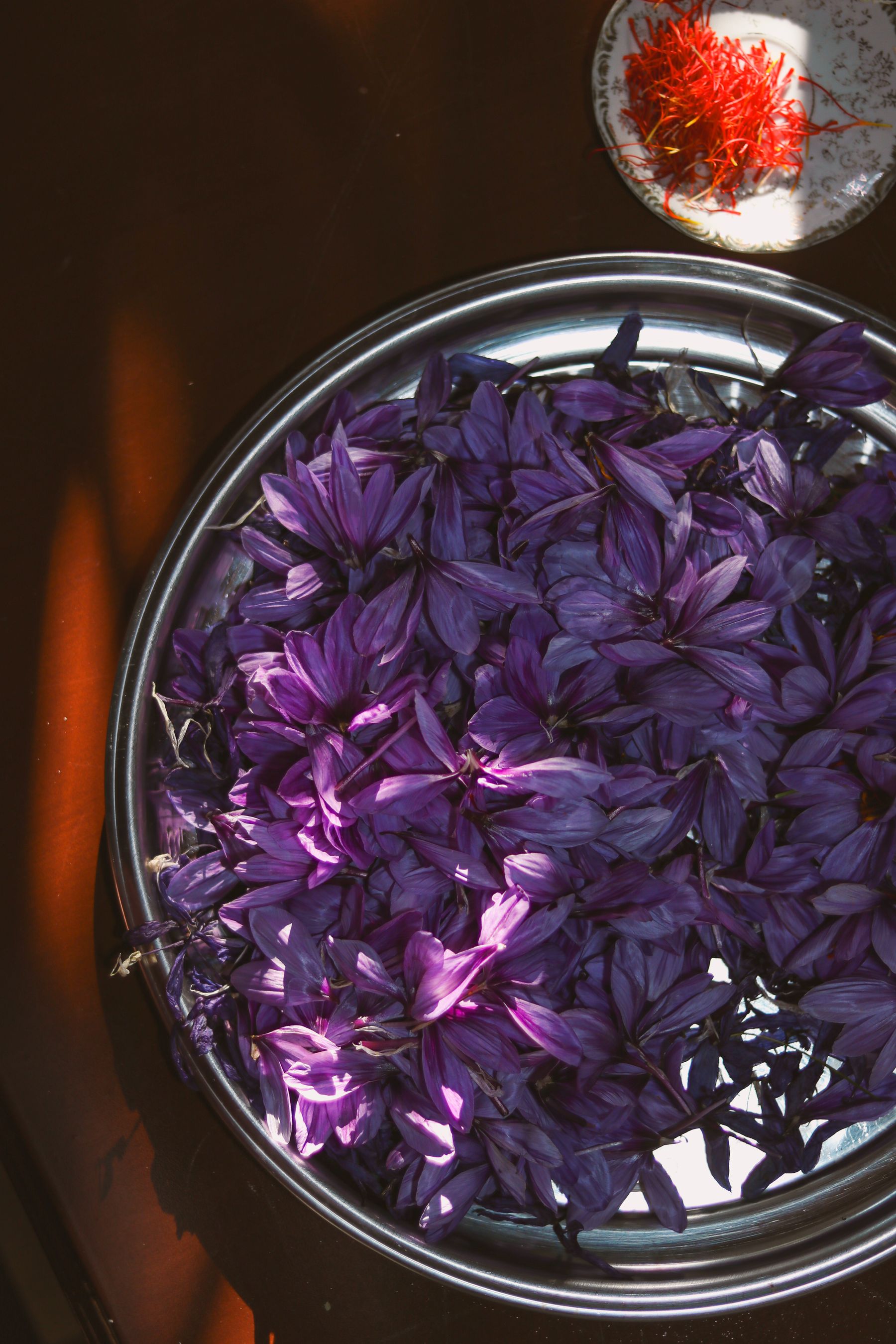
Saffron is the dried stigma of Crocus sativus. Each flower produces three, they have to be picked by hand within hours of opening, and it takes in the region of 150,000 flowers to make a kilogram. That is the entire explanation for both the price and the fraud.
What ISO 3632 actually measures
The international standard for saffron grades it on three laboratory readings, each obtained by ultraviolet-visible spectrophotometry on a water extract of the milled sample:
- Crocin — colouring strength, read at around 440 nm. This is the figure that moves the price, because colour is what most buyers are actually purchasing.
- Picrocrocin — the bitter principle, responsible for taste, read at around 257 nm.
- Safranal — the volatile compound responsible for aroma, read at around 330 nm.
Category I is the top grade, requiring a crocin reading of at least 190. Category II sits between 150 and 190, and Category III below that. Within Category I, trade names describe how the stigma was cut: Mongra (or Shahi) is pure red stigma with the style removed, while Lachha retains a short length of the yellow style.
The critical point for a buyer is that the style contributes weight but almost no colour, taste or aroma. Selling saffron with a generous length of style attached is not fraud — it is simply a lower grade — but it is often priced as though it were not.
The common adulterations
- Safflower. The classic substitute. The florets look superficially similar but they are flat, uniformly orange-red and lack the trumpet flare of a true stigma.
- Dyed corn silk or shredded plant fibre. Cheap, bulky and detectable by the water test below.
- Added style. Genuine saffron, bulked with the near-worthless yellow portion of the same flower.
- Added moisture. Saffron is sold by weight and readily takes up water. A damp lot weighs more, and moulds sooner.
- Added dye or colouring. Applied to lift the apparent colour of a weak lot. This is the one that a laboratory catches and a kitchen sometimes does not.
- Glycerol or oil weighting. Applied to add mass; leaves threads unnaturally supple and slightly greasy to the touch.
Five tests you can run yourself
None of these replaces a laboratory report, but together they will catch most crude adulteration before you get as far as ordering.
- The water test. Drop a few threads into cold water. Real saffron releases its colour slowly, over several minutes, and the threads themselves stay red. Dyed material releases colour almost immediately and the threads go pale as the dye leaves them. This single test catches most of what is sold to consumers as saffron.
- The shape test. Look at a thread under magnification. A true stigma is trumpet-shaped, flaring and serrated at one end. Safflower florets are flat and even along their length.
- The rub test. Rub a thread between damp fingertips. Genuine saffron leaves a yellow-orange stain. A red stain means added dye.
- The taste test. Saffron tastes bitter, not sweet. Anything with a sweet note has probably been treated with honey or syrup, usually to add weight.
- The smell test. Good saffron smells of honey and hay with a slight metallic edge. A flat or chemical smell suggests old material, heavy processing or dye.
What to require commercially
For any lot worth buying, ask for the ISO 3632 laboratory report with all three readings — not just the crocin figure — tied to the specific lot. Ask for the grade name and whether the style has been removed. Ask for the moisture figure, because it directly affects what you are paying for by weight. And ask for a physical sample before you commit, because the tests above take five minutes and will tell you more than a photograph ever will.
We supply ISO 3632 Category I Kashmiri saffron from Pampore, minimum crocin 190, with the laboratory report attached to the lot before any order. If you would like to test it against whatever you are currently buying, that is precisely what we would encourage you to do.